Egg Nutrition Facts
A large raw egg (50 g) contains 72 kcal, 6.3 g protein, 4.8 g fat and 0.4 g carbohydrate. It carries no fiber and almost no sugar. Its standout micronutrients are choline (147 mg), selenium (15.4 µg), vitamin B12 (0.45 µg) and vitamin D (1.0 µg) — eggs are one of the few natural food sources of vitamin D.
Core Nutrients per 100 g
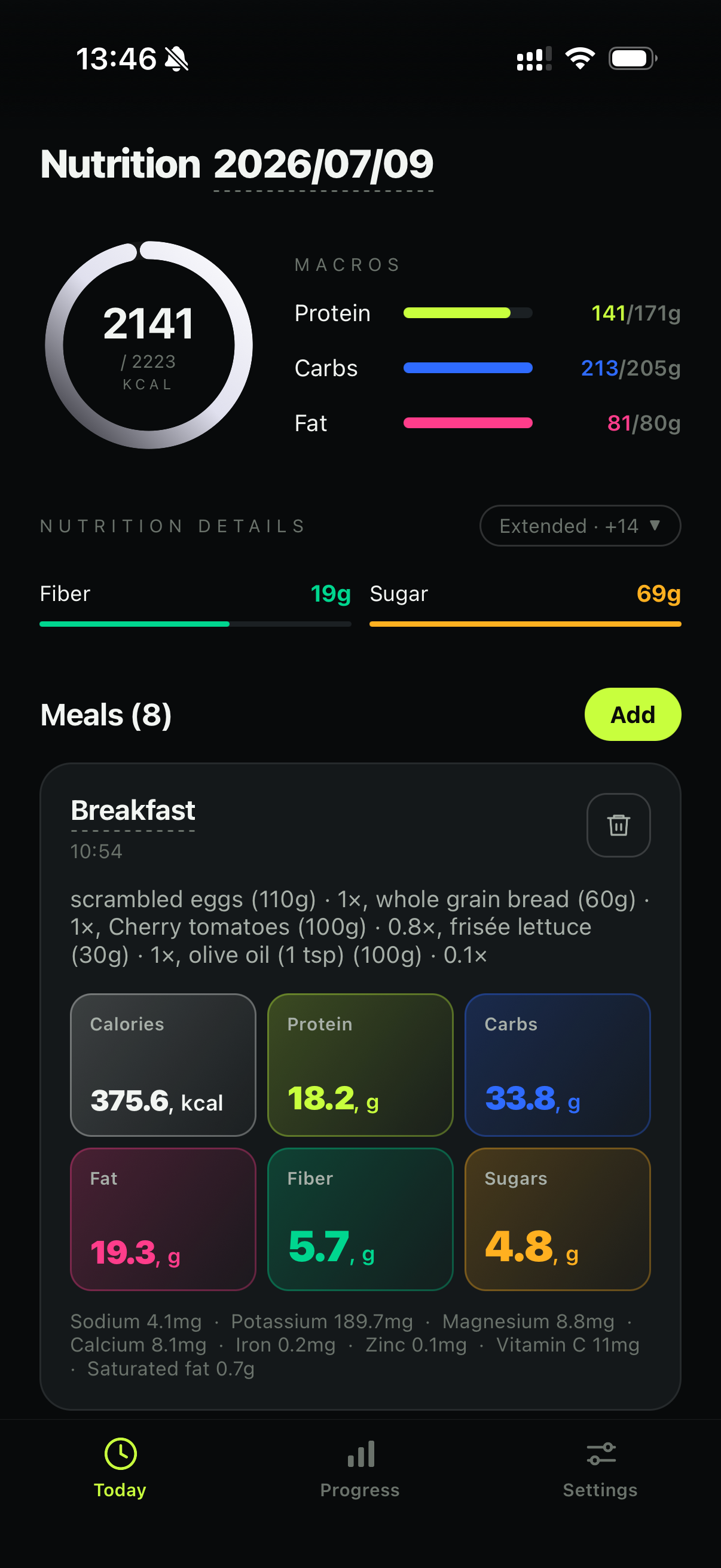
PER 100 G SERVINGThe six values MacroDrop shows on every meal card: energy, the three macros, fiber and sugars.
Extended Nutrients
PER 1 LARGE EGG · 50GGrouped as in the app: lipids, minerals, vitamins and other compounds sit one level below the core six. Daily values follow the FDA 2,000 kcal reference.
How Cooking Changes The Numbers
Per one large egg. The egg itself barely changes — the calories come from what you cook it in.
| Preparation | Kcal | Protein | Fat | Carbs | Note |
|---|---|---|---|---|---|
| Raw, whole | 72 | 6.3 g | 4.8 g | 0.4 g | Reference entry |
| Hard-boiled | 78 | 6.3 g | 5.3 g | 0.6 g | Water loss concentrates it |
| Poached | 72 | 6.3 g | 4.8 g | 0.4 g | Nothing added |
| Fried, 1 tsp oil | 112 | 6.3 g | 9.3 g | 0.4 g | +40 kcal from the oil |
| Scrambled, with milk | 102 | 6.7 g | 7.5 g | 1.3 g | Milk and butter |
| Omelette, in butter | 94 | 6.3 g | 7.3 g | 0.4 g | Half a teaspoon of butter |
Understanding Egg Nutrition
Eggs are one of the most nutrient-dense whole foods available, packing complete protein and over a dozen vitamins and minerals into a single 72-calorie package. The protein in an egg is considered a reference standard for protein quality — every essential amino acid shows up in roughly the ratio the body needs, which is why egg protein is often the benchmark other protein sources get measured against. Most of an egg's fat is unsaturated, and while the yolk carries all of the cholesterol, current research shows dietary cholesterol moves blood cholesterol far less than saturated fat does for most people. Eggs are also unusually rich in choline, a nutrient tied to brain and liver health that most people fall short on, and they're one of the few natural food sources of vitamin D. With almost no carbohydrates and a favorable fat profile, eggs fit easily into high-protein, low-carb, or general balanced eating patterns — which is part of why they show up in more MacroDrop meal logs than almost any other single food.
For athletes and anyone tracking macros closely, eggs are close to an ideal food: 6.3 g of protein for only 72 kcal gives one of the best protein-to-calorie ratios of any whole food, and a leucine profile that contributes meaningfully toward the roughly 2.5–3g of leucine typically needed to help trigger muscle protein synthesis after training — usually reached with two to three eggs rather than one. They work equally well in a bulk or a cut — keep the yolks for more calories and micronutrients while bulking, lean toward whites for a higher protein-to-calorie ratio while cutting — and they're fast to prep, cheap, and an easy way to hit a daily protein target without extra planning. Because the amino acid profile is complete and highly bioavailable, eggs pair well with slower-digesting proteins across a meal plan, and their near-zero carb content means they slot into almost any macro split without pulling carb or fat numbers off target.
Frequently Asked Questions
How many calories are in one egg?
One large raw egg (50 g) has 72 kcal. A medium egg (44 g) is about 63 kcal, an extra-large (56 g) about 80 kcal. Boiling and poaching add nothing; frying in a teaspoon of oil adds roughly 40 kcal.
How much protein is in an egg?
6.3 g per large egg — roughly 3.6 g in the white and 2.7 g in the yolk. Egg protein scores above 1.0 on DIAAS, so every essential amino acid is present in a usable ratio.
Are eggs high in cholesterol?
A large egg holds 186 mg of dietary cholesterol, all in the yolk. Dietary cholesterol moves blood LDL far less than saturated fat does for most people, and the 2015 US Dietary Guidelines dropped the 300 mg daily cap.
Which nutrients are eggs richest in?
Choline (147 mg, 27% DV), selenium (15.4 µg, 28% DV), vitamin B12 (0.45 µg, 19% DV) and riboflavin (0.23 mg, 18% DV) — all inside 72 kcal. Eggs are also one of the few foods that naturally contain vitamin D.
Egg white or whole egg?
The white gives 57% of the protein for 17 kcal and no fat. The yolk holds all the fat, all the cholesterol and nearly all the micronutrients. Whites-only cuts calories; whole eggs win on nutrient density.
Do boiled eggs have different nutrients?
Cooking drives off water, so per-100 g figures rise slightly, but per egg the shift is small: 78 kcal hard-boiled versus 72 kcal raw. Frying and scrambling add calories from the fat and milk you use, not from the egg.
Log the egg in two seconds
MacroDrop tracks all of these nutrients — core and extended — from a photo, your voice or a barcode. Offline USDA database, 7,800 foods.
Values come from the USDA FoodData Central SR Legacy entry Egg, whole, raw, fresh (FDC ID 748967, NDB 01123), scaled from per-100 g to a 50 g large egg. Daily values follow the FDA 2,000 kcal reference. Cooked figures use the matching SR Legacy cooked entries. Last reviewed August 2026.